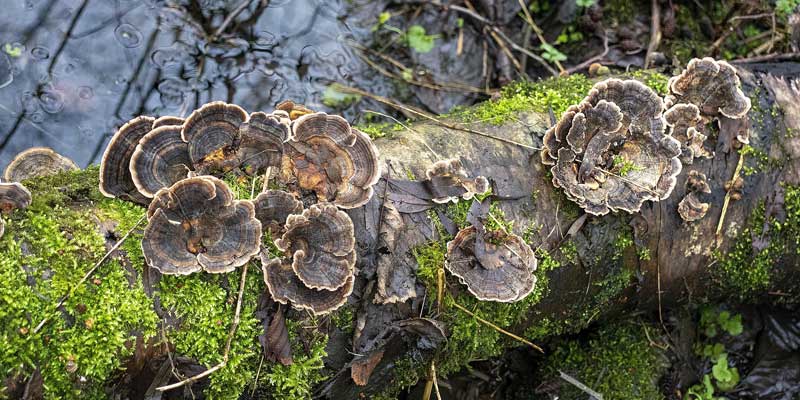
A 2012 University of Pennsylvania veterinary study gave a turkey tail compound to dogs with hemangiosarcoma — an aggressive, often-fatal cancer — and the highest-dose group survived markedly longer than historical rates for surgery alone. That result is a big part of why turkey tail is discussed in veterinary oncology circles, not just holistic ones.
The honest follow-up: a larger 2022 study didn’t confirm the same dramatic result when compared directly against chemotherapy — chemo alone outperformed turkey tail alone. So the accurate picture is that turkey tail supports the immune system and may help in specific situations, not that it’s a proven cancer treatment on its own.
Editor’s Pick

Last update on 2026-10-13 / Affiliate links / Images from Amazon Product Advertising API
Host Defense was founded by mycologist Paul Stamets, and the capsules are certified organic, non-GMO, and grown in the USA. It’s a mushroom-focused supplement maker, not a general supplement company that added turkey tail to a catalog.
- TypeCapsules
- Size120 count
- FormatMycelium-based
- Best ForGeneral immune support
What’s Inside!
- 1 – What Turkey Tail Mushroom Does
- 2 – Turkey Tail Supplement Comparison Table
- 3 – Turkey Tail Supplement Reviews
- 3.1 – 1. Host Defense (Best Overall)
- 3.2 – 2. NatureBell (Best Value Capsules)
- 3.3 – 3. Double Wood Supplements (Best Third-Party-Tested Capsules)
- 3.4 – 4. Four Leaf Rover (Best Whole-Fruiting-Body Powder)
- 3.5 – 5. Real Mushrooms (Best Lab-Verified Capsules)
- 3.6 – 6. NaturVet (Best Chews)
- 3.7 – 7. BulkSupplements (Best Value Powder)
- 4 – Which Turkey Tail Supplement Should You Buy?
- 5 – Turkey Tail Mushroom FAQ
- 6 – Final Thoughts
What Turkey Tail Mushroom Does
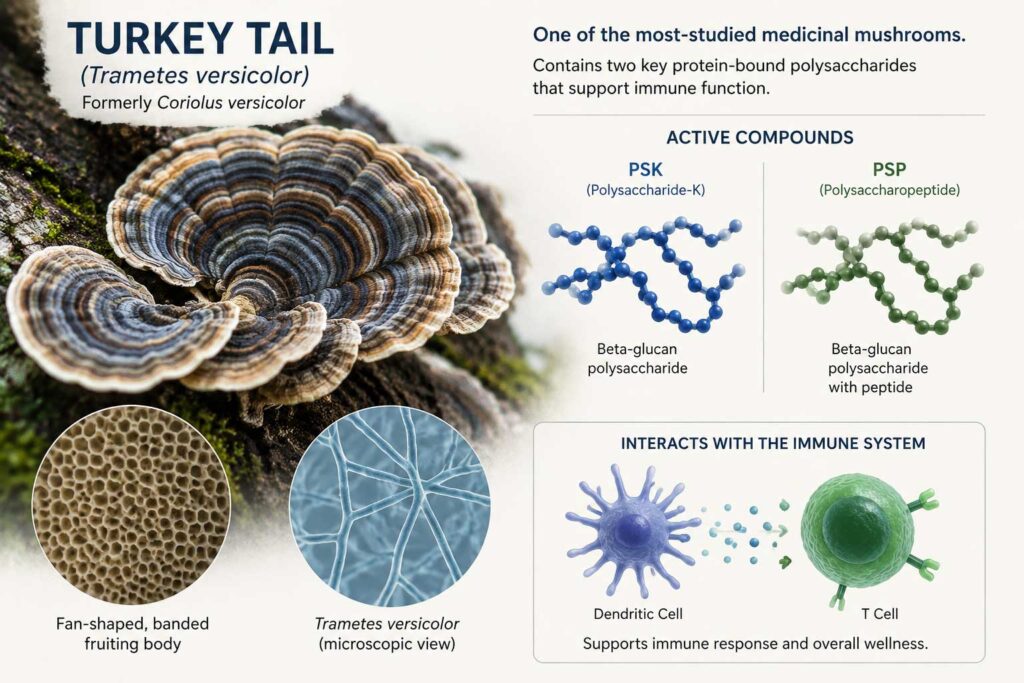
Turkey tail (Trametes versicolor, formerly Coriolus versicolor) is one of the most-studied medicinal mushrooms — its fan-shaped, banded appearance is where the name comes from. The compounds researchers focus on are two protein-bound polysaccharides: PSK (polysaccharide-K) and PSP (polysaccharopeptide), both beta-glucan-containing molecules that interact with the immune system.
The Research, Honestly Presented
In 2012, Dr. Dorothy Cimino Brown’s team at the University of Pennsylvania School of Veterinary Medicine published a study on dogs with naturally occurring splenic hemangiosarcoma. Fifteen dogs received a standardized PSP extract at one of three doses after surgery, with no other treatment. The highest-dose group showed a longer median survival than historical outcomes for surgery alone — a striking result for a small pilot study.
A follow-up 2022 study compared turkey tail against actual chemotherapy in dogs with hemangiosarcoma and did not confirm the same dramatic benefit — dogs receiving chemotherapy had longer survival times than those on turkey tail alone, and adding turkey tail to chemotherapy didn’t significantly change outcomes. If your dog has been diagnosed with hemangiosarcoma or another cancer, this is a conversation to have directly with your veterinary oncologist — turkey tail may be a reasonable complementary support, but it isn’t a substitute for what your vet recommends.
Separate from the cancer research, there’s mechanistic evidence for how these compounds work: PSK has been shown to bind to a receptor called TLR2 on immune cells, triggering immune cell maturation and activity. This is the basis for turkey tail’s broader “immune support” reputation beyond the cancer-specific research.
Other Reported Benefits
Beyond the cancer research, turkey tail is used for general immune modulation, as a prebiotic supporting gut bacteria, and for its antioxidant phytonutrient content (phenolic compounds like gallic acid and catechin). These uses have less rigorous canine-specific research behind them than the hemangiosarcoma study, but they’re the basis for turkey tail’s use as a general senior-dog wellness supplement.
Types of Turkey Tail Supplements
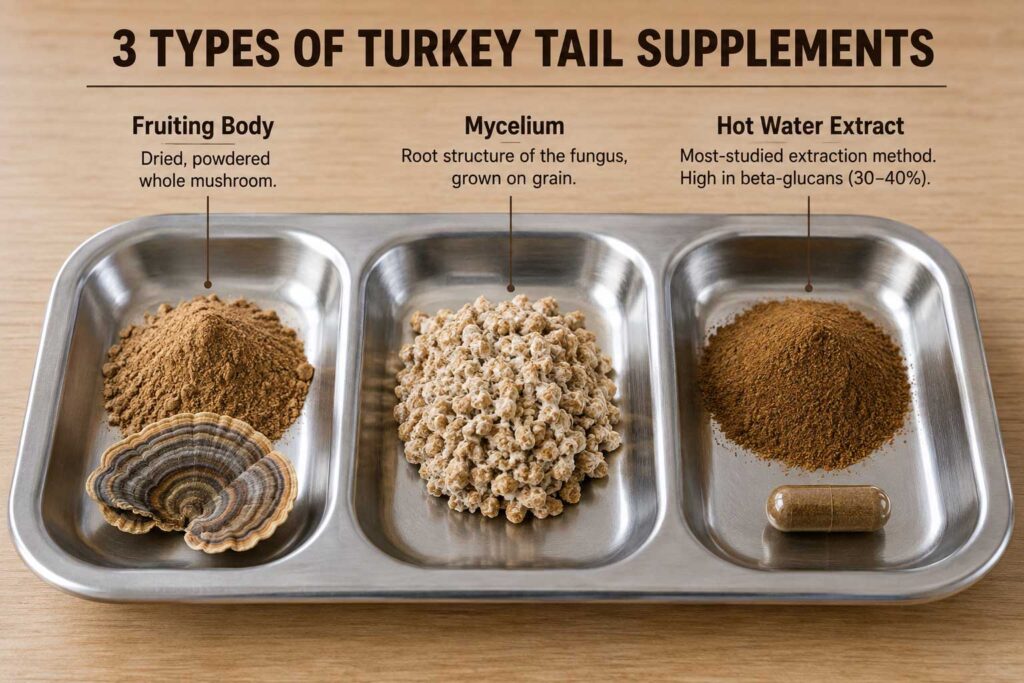
Fruiting body — the dried, powdered whole mushroom. Raw fruiting body isn’t easily digestible for dogs due to the chitin in its cell walls, which is why hot-water extraction matters (see below) rather than feeding raw powder directly.
Mycelium — the root structure of the fungus, typically grown on grain. Naturally lower in beta-glucans than the fruiting body; if a mycelium product claims high beta-glucan content, it’s worth checking whether that’s coming from the mushroom itself or an added source.
Hot water extract — the most common and most-studied preparation method. This process breaks down the indigestible cell walls, making the beneficial compounds bioavailable, and typically yields a much higher beta-glucan concentration (commonly 30–40%) than raw mycelium.
Dosing Guidance
A commonly used heuristic across mushroom-supplement sources is roughly 20–30mg of beta-glucans per kg of body weight, though actual dosing varies by product concentration — always follow the specific product’s label rather than a generic rule. A few product-specific examples:
- Canine Matrix-style powders: roughly ½ teaspoon (1g) per 25 lbs of body weight daily
- Real Mushrooms capsules: 1 capsule per 20 lbs of body weight daily
Always check the beta-glucan percentage on the label — two products with the same capsule count or gram weight can differ significantly in actual active compound content. And talk to your vet before starting any mushroom supplement if your dog is on other medications, since immune-modulating compounds can interact with immunosuppressants or other treatments.
How to Give Turkey Tail to Your Dog
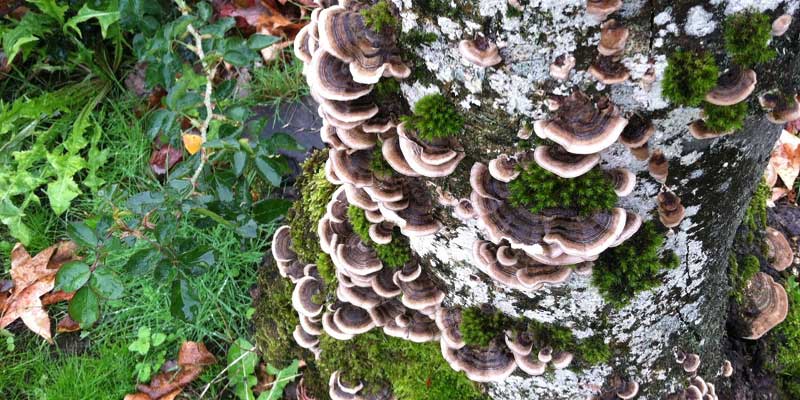
Don’t feed raw mushroom directly — the indigestible cell walls mean your dog won’t absorb much benefit, and it can cause digestive upset. Give it between meals if you can, and if your dog isn’t a fan of the taste, mixing it into bone broth or kefir works well for both powders and opened capsules.
A Quality Consideration: Heavy Metals
Mushrooms absorb minerals — including heavy metals like lead — from the soil or substrate they’re grown in. Several mushroom supplements carry Prop 65 warnings for this reason. It’s not automatically disqualifying, but it’s worth favoring brands that publish third-party lab testing results or a Certificate of Analysis, rather than assuming “organic” alone covers this.
Turkey Tail Supplement Comparison Table




Last update on 2026-10-13 / Affiliate links / Images from Amazon Product Advertising API
Turkey Tail Supplement Reviews
1. Host Defense (Best Overall)
Best Overall
Last update on 2026-10-13 / Affiliate links / Images from Amazon Product Advertising API
- TypeCapsules
- Size120 count
- FormatMycelium-based
- Best ForGeneral immune support
Host Defense was founded in 1980 by mycologist Paul Stamets, originally under the name Fungi Perfecti — mushroom cultivation is the company’s sole focus, rather than a single supplement line among many. The capsules are grown on the company’s own certified-organic farm in Washington State and are non-GMO.
It’s formulated primarily for digestive and immune support, with prebiotic properties from the fermented rice substrate. Being mycelium-based rather than fruiting-body extract means the beta-glucan concentration runs lower than a hot-water extract product — check the beta-glucan percentage against the fruiting-body options on this list if that number matters most to you.
It’s priced at the higher end of this list. Host Defense reports being the best-selling mushroom supplement brand in the U.S. by sales, per SPINS natural-channel tracking data the company cites — a market-share figure, not independent lab testing, but it does reflect how widely used the brand is outside the dog-specific niche this list covers.
Pros
- From a specialized mycology brand
- Certified organic, non-GMO, USA-grown
- Best-selling brand in the category
Cons
- Mycelium-based — lower beta-glucan concentration than fruiting-body extracts
- Pricier than several alternatives here
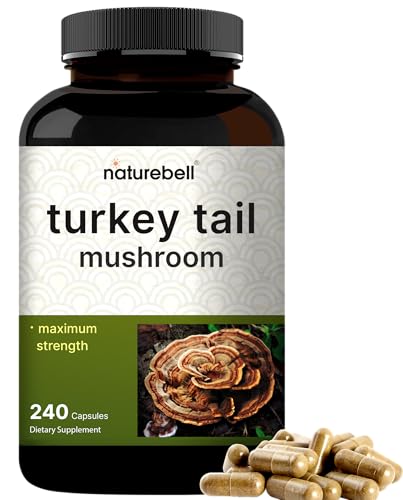
2. NatureBell (Best Value Capsules)
Best Value Capsules
Last update on 2026-10-13 / Affiliate links / Images from Amazon Product Advertising API
- TypeCapsules
- Size240 count, 600mg per serving
- FormatExtract
- Best ForBudget-conscious, larger dogs
Worth being upfront about: this is formulated as a human supplement, not a dog-specific product — it doesn’t contain soy, GMO, gluten, or dairy, which makes it reasonably safe to use off-label, but you’ll need to calculate dosing by weight yourself rather than following a dog-specific label. It’s third-party lab-tested and produced in a cGMP-certified facility.
At 240 capsules for the price, it’s among the better per-dose values here, and the higher capsule count means fewer refills for a larger dog that needs more per serving than the dosing guidance above suggests for a smaller breed.
If you’d rather have exact dog-specific dosing instructions printed directly on the label, one of the pet-specific products elsewhere on this list may be a better fit, despite the higher per-serving cost.
Pros
- Strong value — 240 capsules
- Third-party lab tested
- Free of common allergens (soy, gluten, dairy)
Cons
- Human product — no dog-specific dosing on the label
- Requires calculating your own dosage by weight
3. Double Wood Supplements (Best Third-Party-Tested Capsules)
Best Third-Party-Tested Capsules

Last update on 2026-10-13 / Affiliate links / Images from Amazon Product Advertising API
- TypeCapsules
- Size120 count, 2-month supply
- FormatExtract
- Best ForQuality-conscious buyers
Double Wood tests each batch through an outside lab for identity, heavy metals, and microbial contamination — the most recent certificate of analysis the company published passed on all counts, which is directly relevant given the heavy-metal concern covered earlier in this guide. One serving (2 capsules) delivers 1,000mg of turkey tail, drawn from fruiting body, mycelium, and extracellular compounds rather than fruiting body alone.
Grown and encapsulated in the USA, it’s positioned as both an antioxidant source and a digestive-support prebiotic. Like NatureBell, this is a human-formulated product used off-label for dogs — safe, but you’re calculating the dose yourself rather than following pet-specific label instructions.
120 capsules works out to a two-month supply at standard dosing.
Pros
- Batch-tested for heavy metals and contaminants
- 1,000mg per serving
- Grown and made in the USA
Cons
- Human product — calculate dog dosing yourself
- Not turkey-tail-specific brand (broader supplement catalog)
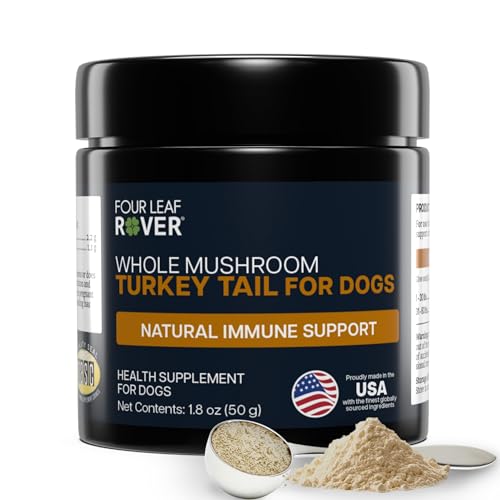
4. Four Leaf Rover (Best Whole-Fruiting-Body Powder)
Best Whole-Fruiting-Body Powder
Last update on 2026-10-13 / Affiliate links / Images from Amazon Product Advertising API
- TypePowder
- FormatWhole fruiting body, double-extracted
- Beta-GlucansMinimum 50%
- Best ForMaximum potency, verified quality
Four Leaf Rover uses whole fruiting body rather than mycelium, double-extracted, with a guaranteed minimum 50% beta-glucan content — meaningfully higher than most mycelium-based products can claim. It’s a dog-specific brand rather than a repurposed human supplement, founded by Dana Scott after she lost two dogs to environmental toxin exposure; the company built its testing standards around minimizing pesticide and heavy-metal contamination in its products.
Every batch is tested by an outside lab for identity, purity, and beta-glucan content before sale, per the company — a second layer of testing on top of the fruiting-body-only sourcing.
It also functions as a prebiotic, supporting gut bacteria alongside the immune-modulating effects. The tradeoff is that whole-fruiting-body, high-beta-glucan products typically cost more than mycelium-based capsules.
Pros
- Whole fruiting body with guaranteed 50%+ beta-glucans
- Per-batch third-party testing
- Dog-specific formulation, not a repurposed human product
Cons
- Pricier than mycelium-based alternatives
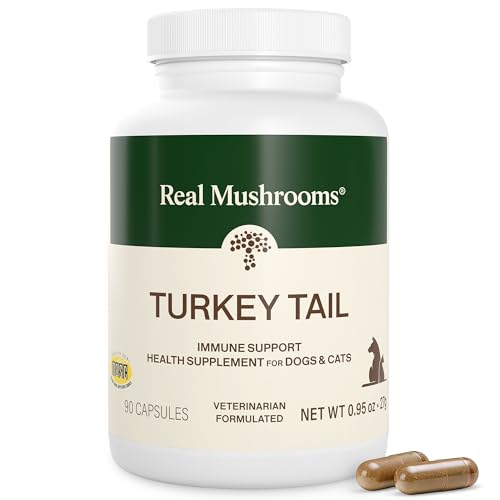
5. Real Mushrooms (Best Lab-Verified Capsules)
Best Lab-Verified Capsules
Last update on 2026-10-13 / Affiliate links / Images from Amazon Product Advertising API
- TypeCapsules
- Size90 count
- Beta-GlucansVerified >30%
- Best ForPets specifically, hot-water extracted
Real Mushrooms is formulated specifically for pets, hot-water-extracted for digestibility (rather than raw fruiting bodies or mycelium alone), and lab-verified at over 30% beta-glucans per serving — a specific number rather than a marketing claim. Made in an NSF-certified facility. The company, a family-run business, also conducts a nuclear magnetic resonance authenticity test on each batch to confirm that the mushroom content matches the label, in addition to beta-glucan verification.
It’s formulated by a veterinarian (Dr. Rob Silver), and the company publishes clear dosing guidance: 1 capsule per 20 lbs of body weight daily. That’s clearer guidance than most competing products give on the label.
It doesn’t contain starch, mycelium, or grain filler, which is a shorter ingredient list than several capsule competitors — though that pushes the price moderately above the budget options here.
Pros
- Pet-specific formulation with clear dosing guidance
- Lab-verified beta-glucan content
- Hot-water extracted for digestibility
Cons
- Smaller count (90) than some capsule competitors
- Moderately priced above the budget options here
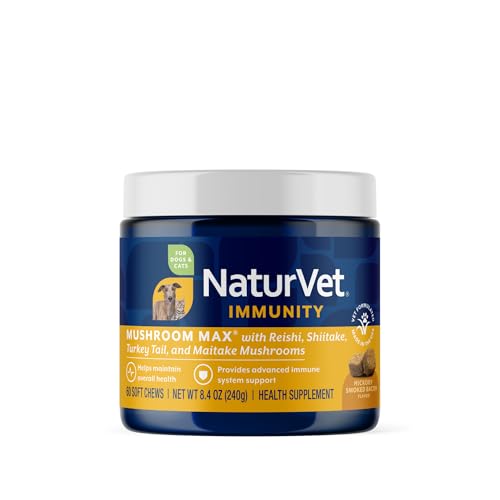
6. NaturVet (Best Chews)
Best Chews
Last update on 2026-10-13 / Affiliate links / Images from Amazon Product Advertising API
- TypeSoft chews
- Size60 count
- FormatMulti-mushroom blend
- Best ForDogs who won’t take capsules or powder
Worth being clear about: this isn’t a turkey-tail-only product — it’s a blend of reishi, shiitake, maitake, and turkey tail, plus vitamins C and E, CoQ10, and selenium. That’s not a downside if you want broader mushroom support, but it does mean the turkey-tail-specific dose is lower than a dedicated product, and the label doesn’t list a beta-glucan percentage.
Format is the appeal here: vet-formulated, hickory-smoked-bacon-flavored soft chews are dramatically easier to get into a dog that won’t eat powder or take a capsule. Dosing scales by weight (1 chew for dogs up to 25 lbs, up to 6 for dogs over 100 lbs).
Made in the USA and wheat-free. NaturVet is a founding member of the National Animal Supplement Council (NASC), an industry body that requires member companies to follow cGMP manufacturing standards and submit to independent audits — a more formal oversight layer than most of the human-formulated products on this list carry, and directly relevant given the heavy-metal consideration above.
Pros
- By far the easiest format for a picky dog
- Vet-formulated, dosing scales by weight
- Broader mushroom-blend support
Cons
- Not turkey-tail-specific — lower dose per chew than a dedicated product
- No beta-glucan percentage listed
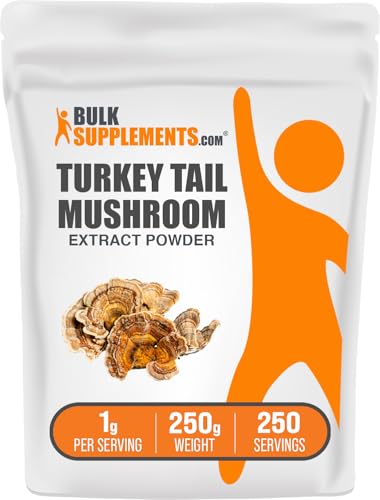
7. BulkSupplements (Best Value Powder)
Best Value Powder
Last update on 2026-10-13 / Affiliate links / Images from Amazon Product Advertising API
- TypePowder
- Size250g (up to 5kg available)
- FormatExtract
- Best ForLong-term use, multi-dog households
If you’re planning to use turkey tail long-term or have more than one dog, BulkSupplements’ scaling — available up to a 5kg bag — brings the per-gram cost down substantially compared to any capsule product on this list. It’s vegan, gluten-free, and made in a cGMP-compliant facility.
Like the other human-formulated products here, you’re calculating your own dosing by weight rather than following a pet-specific label, and there’s no published beta-glucan percentage, so you’re trusting the extraction process rather than a verified number.
For a household already comfortable measuring supplements by weight, this is the most economical way to consistently keep turkey tail on hand.
Pros
- Scales up to 5kg — best long-term value
- Vegan, gluten-free, cGMP-compliant
- Ideal for multi-dog households
Cons
- No beta-glucan percentage published
- Requires calculating your own dosing
Which Turkey Tail Supplement Should You Buy?
| Situation | Pick |
|---|---|
| Not sure where to start | Host Defense |
| Larger dog, want the best per-dose value | NatureBell |
| Want verified third-party testing | Double Wood Supplements |
| Want maximum verified potency | Four Leaf Rover |
| Want pet-specific dosing instructions | Real Mushrooms |
| Dog won’t take capsules or powder | NaturVet |
| Long-term use or multiple dogs | BulkSupplements |
Turkey Tail Mushroom FAQ
Does turkey tail mushroom help dogs with cancer?
The honest answer is: it may help as a complementary support, but it isn’t a proven standalone treatment. A 2012 University of Pennsylvania study found dogs with hemangiosarcoma given turkey tail extract lived longer than historical outcomes for surgery alone — a promising result. A larger 2022 follow-up didn’t confirm the same benefit when compared directly against chemotherapy. If your dog has cancer, talk to your veterinary oncologist about whether turkey tail makes sense alongside your dog’s actual treatment plan.
How much turkey tail should I give my dog?
It depends on the product’s beta-glucan concentration, so always check the specific label. A commonly used general guideline is 20–30mg of beta-glucans per kg of body weight. Some products publish simpler dosing: roughly ½ teaspoon of powder per 25 lbs, or 1 capsule per 20 lbs for some capsule products. Check your specific product’s label and consult your vet, especially if your dog is on other medications.
Is raw turkey tail mushroom safe for dogs?
Feeding the raw, whole mushroom isn’t recommended — the cell walls contain chitin that dogs can’t easily digest, meaning your dog won’t absorb much benefit, and it can cause digestive upset. Hot-water-extracted powders, capsules, and properly prepared supplements solve this by breaking down the indigestible parts during processing.
What’s the difference between mycelium and fruiting body products?
Fruiting body is the mushroom itself, generally higher in beta-glucans when properly extracted. Mycelium is the root structure, often grown on grain, and naturally lower in beta-glucans unless a product adds them from another source. Neither is inherently unsafe, but if maximizing active-compound content is your priority, a hot-water-extracted fruiting body product with a published beta-glucan percentage is the stronger choice.
Should I worry about heavy metals in mushroom supplements?
It’s a known consideration — mushrooms absorb minerals, including heavy metals, from what they’re grown in, which is why some listings carry Prop 65 warnings. It doesn’t mean every product is unsafe, but it’s worth favoring brands that publish third-party lab testing or a Certificate of Analysis rather than assuming “organic” alone addresses it.
Final Thoughts
Turkey tail has more research behind it than most mushroom supplements marketed to dog owners, but the full picture includes both the promising 2012 result and the more measured 2022 follow-up, which didn’t hold up against chemotherapy. Treat it as an immune-support supplement to discuss with your vet rather than a cancer treatment on its own, and check the beta-glucan percentage on the label before assuming a product’s potency — brands that publish real third-party testing results are the ones worth trusting with that number.

I bought a pack of host defense earlier for my Yorkie, and this time, I was looking for something better option and find out it’s already the best. Now I am sticking with it.
Great article. Couldn’t be written far better!
Best regards,
Abildgaard Griffin
Thanks so much for the great info. Can you list the dosage amounts and frequency for a dog by weight. With gratitude, Adam