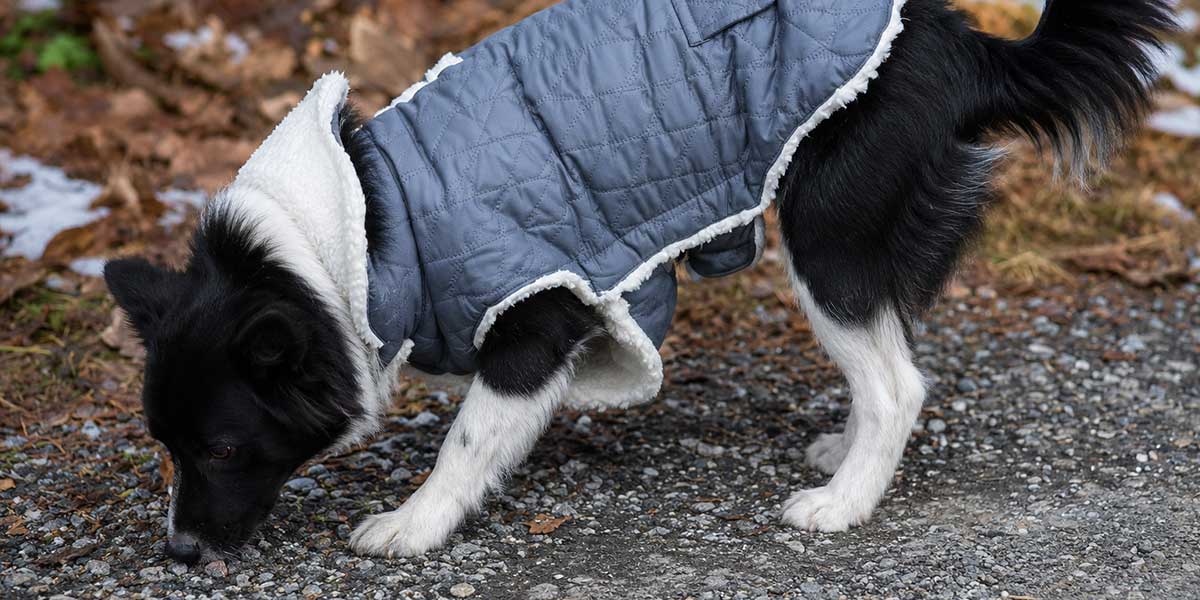
Not all cold-weather jackets are built for snow, and the difference matters more than it sounds. A jacket that’s only water-resistant can soak through in wet snow, and once that happens, the insulation holds cold water directly against your dog’s skin — worse than no jacket at all in that moment. A jacket rated waterproof, not just water-resistant, is the distinction to check before buying.
Watch for hypothermia signs too: shivering, lethargy, weakness, and shallow breathing. And don’t assume every dog needs heavy insulation — a double-coated breed wearing a thick jacket can overheat, so if your dog seems hot, take it off.
Editor’s Pick
Last update on 2026-10-13 / Affiliate links / Images from Amazon Product Advertising API
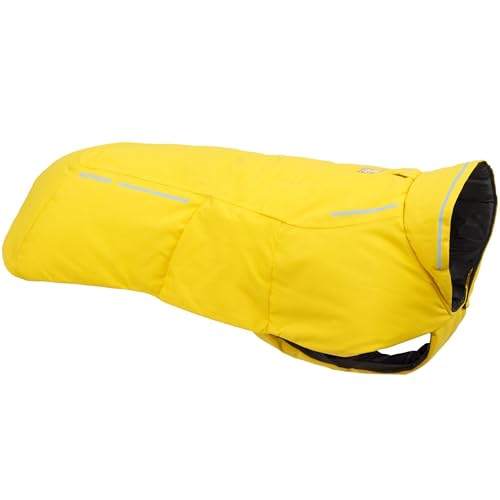
Waterproof, not just water-resistant, rated to 10,000 mm with high-loft recycled insulation — the distinction that matters most once your dog is out in wet snow.
What’s Inside!
- 1 – Does Your Dog Need a Jacket?
- 2 – What Matters in the Fabric and Fit
- 3 – Snow Jacket Comparison Table
- 4 – Snow Jacket Reviews
- 4.1 – 1. RuffWear Vert (Best Overall/Truly Waterproof)
- 4.2 – 2. AOFITEE Fullbody Snowsuit (Best for Small Dogs)
- 4.3 – 3. Ezierfy Rain Poncho (Best Budget/Lightweight Shell)
- 4.4 – 4. Hurtta Extreme Overall (Best for Extreme Cold)
- 4.5 – 5. Carhartt Firm Duck Insulated Chore Coat (Best Durable/Workwear-Style)
- 5 – Which Snow Jacket Should You Buy?
- 6 – Snow Jackets for Dogs FAQ
- 7 – Final Thoughts
Does Your Dog Need a Jacket?
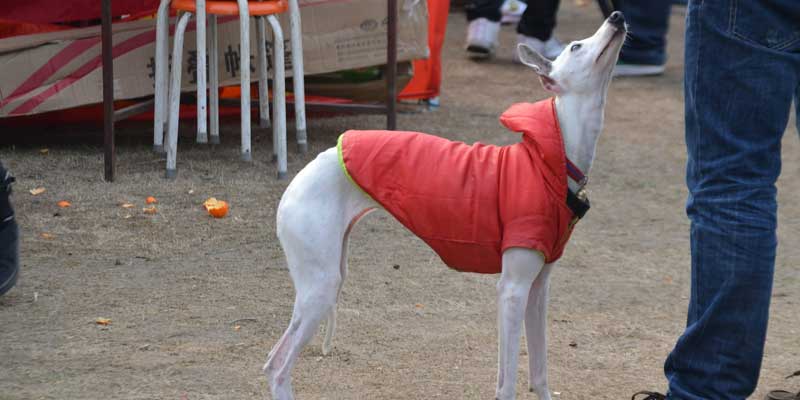
Short-haired dogs lack the natural coat insulation that double-coated breeds have. Thin dogs lose heat faster due to less body fat. Sick or recovering dogs need extra warmth support. Puppies and small breeds have a higher surface-area-to-body-mass ratio, meaning they lose heat faster relative to their size — an established physiological reason toy breeds and puppies get cold quicker than large dogs. Senior dogs are more vulnerable to illness generally, cold included.
Double-coated Arctic breeds like Huskies and Malamutes are naturally more resistant to cold, and a jacket can cause them to overheat rather than help. Watch your dog’s behavior, not just the thermometer — if they seem hot, take the jacket off.
What Matters in the Fabric and Fit
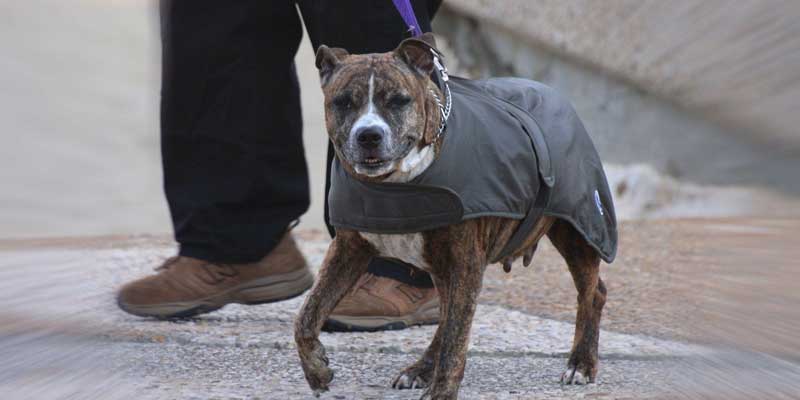
Waterproof, not just water-resistant. Check the label for the actual claim rather than assuming “winter jacket” means waterproof — plenty of jackets marketed for snow are only water-resistant.
Insulation. Multi-layer, adequately thick insulation matters in freezing temperatures; thin insulation won’t keep a dog warm once the temperature actually drops.
Sizing and coat length. Measure your dog’s height, length, and chest before buying — the coat shouldn’t cross the waist or restrict movement, and it should be secure without causing discomfort.
Durability and attachment method. A dog that chews may need a more durable jacket, and buckles or snaps are safer than zippers for long-haired dogs, which can get caught.
Reflective elements. Useful for visibility to drivers and for keeping track of your dog in low light or snowfall.
Watch for hypothermia symptoms during cold-weather outings. Shivering, lethargy, weakness, and shallow breathing are early signs. Left unaddressed, symptoms can progress to a dangerously low heart rate. Get your dog warm and contact a vet if you notice these signs, especially if shivering has stopped — that can indicate the condition has worsened, not improved.
Snow Jacket Comparison Table


Last update on 2026-10-13 / Affiliate links / Images from Amazon Product Advertising API
Snow Jacket Reviews
1. RuffWear Vert (Best Overall/Truly Waterproof)
Best Overall/Truly Waterproof
Last update on 2026-10-13 / Affiliate links / Images from Amazon Product Advertising API
- ShellWaterproof, windproof, breathable
- InsulationHigh-loft recycled polyester
- Best ForNot sure where to start
RuffWear rates the shell to 10,000 mm of waterproofness, built from 70-denier ripstop nylon with a nonfluorinated water-repellent coating — a real number rather than just a “water-resistant” label. Extended coverage over the hips and thighs goes beyond the torso-only cut most competitors use, and the insulation is 120-gram recycled polyester.
An oversized storm collar folds up for extra protection, and optional leg loops keep the jacket from sliding around in wind. A detailed customer account describes wearing it through an entire Midwest winter, in both snow and rain, without the insulation ever getting wet through. RuffWear also backs the jacket with a lifetime replacement guarantee it calls the Trail Tested Promise, and it has a leash portal on the back so it can go on over most harnesses.
It’s the most expensive jacket in this lineup.
Pros
- Waterproof to a 10,000 mm rating, not just water-resistant
- High-loft recycled insulation with extended hip and thigh coverage
- Leg loops for a secure fit in wind, plus a lifetime replacement guarantee
Cons
- Most expensive jacket in this lineup
2. AOFITEE Fullbody Snowsuit (Best for Small Dogs)
Best for Small Dogs

Last update on 2026-10-08 / Affiliate links / Images from Amazon Product Advertising API
- CoverageFull body, including all four legs
- MaterialsIncludes recycled content
- Best ForToy breeds and small dogs specifically
This is one of the most reviewed snowsuits in this size category, and part of the material is recycled — a detail budget-priced snowsuits this size don’t always include.
Full leg coverage matters more for small dogs than large ones: they sit closer to the snow and have proportionally more surface area exposed to cold ground for their size, so they lose heat there faster too.
The puffer-style construction is warm, but it’s bulkier than a sleeker jacket.
Pros
- Full four-leg coverage
- One of the most reviewed snowsuits in this size range
- Includes recycled materials
Cons
- Bulkier than a standard torso-only jacket
3. Ezierfy Rain Poncho (Best Budget/Lightweight Shell)
Best Budget/Lightweight Shell

Last update on 2026-10-13 / Affiliate links / Images from Amazon Product Advertising API
- TypeLightweight shell, not insulated
- RecognitionAmazon’s Choice, substantial monthly sales
- Best ForLayering over a fleece, mild wet conditions
This one carries an Amazon’s Choice badge and a high volume of current sales. Amazon’s Choice is a rotating badge based on recent sales and reviews, not a fixed rating, so it’s more a snapshot of the moment than a lasting endorsement.
It’s a lightweight shell, not an insulated jacket — pair it with a fleece layer underneath for wet, moderately cold conditions rather than expecting it to provide warmth on its own in deep cold.
It won’t keep a dog warm in freezing temperatures on its own.
Pros
- Amazon’s Choice badge and strong current sales
- Lightweight, good for layering
- Budget-friendly
Cons
- Not insulated — needs a fleece layer underneath in genuine cold
4. Hurtta Extreme Overall (Best for Extreme Cold)
Best for Extreme Cold
Last update on 2026-10-13 / Affiliate links / Images from Amazon Product Advertising API
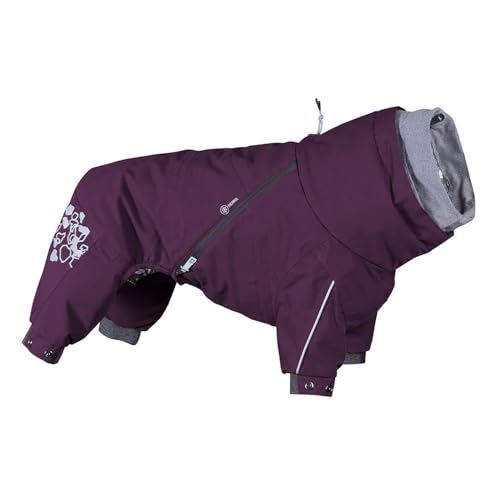
- CoverageFull overall — legs, abdomen, chest
- TechnologyFoil lining reflects body heat
- Best ForDogs that get cold easily, genuinely extreme conditions
The lining is an aluminum foil layer woven into recycled polyester, which Hurtta’s own product specs describe as reflecting body heat back toward the dog instead of just trapping it. The hood is heavily padded and cut high to protect the ears from wind and blowing snow — Hurtta designed it with short-haired, cold-sensitive dogs in mind.
Full overall coverage protects the abdomen, chest, and legs — areas a standard jacket leaves exposed. The shell carries a 10,000 mm water-column rating with taped seams and a fluorocarbon-free water-repellent finish, and Hurtta rates the suit for outdoor temperatures down to roughly -22°F (-30°C).
This level of coverage is more than most dogs in milder climates need.
Pros
- Foil-lined recycled polyester reflects body heat
- Full coverage rated to roughly -22°F (-30°C)
- Padded, high-cut hood protects the ears
Cons
- More coverage than most dogs in milder climates need
5. Carhartt Firm Duck Insulated Chore Coat (Best Durable/Workwear-Style)
Best Durable/Workwear-Style
Last update on 2026-10-13 / Affiliate links / Images from Amazon Product Advertising API
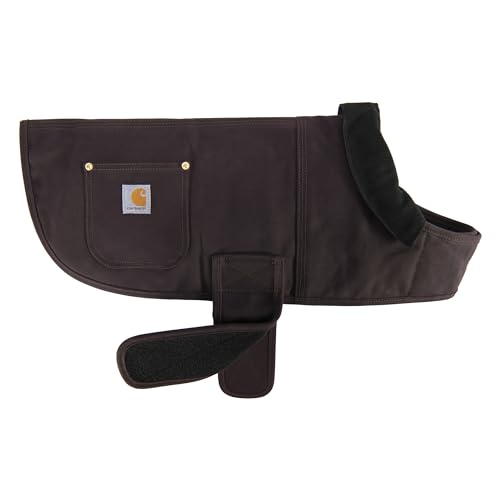
- MaterialFirm-hand duck canvas
- LiningQuilted, corduroy collar
- Best ForActive, durable-material preference
The duck canvas shell is more rugged than the nylon most competitors use. Carhartt has made workwear since 1889, and this coat is cut from the same firm-hand duck canvas as its human work jackets rather than a fabric designed just for pet gear.
The quilted liner and corduroy collar add warmth, and a vented collar design adds breathability that most insulated jackets skip.
It’s water-repellent, not fully waterproof — fine for snow and light rain, but not for a prolonged soaking, since the same wet-insulation problem that affects any water-resistant-only shell applies here too.
Pros
- Rugged duck canvas material
- Carhartt has made workwear since 1889
- Vented collar adds breathability
Cons
- Water-repellent, not fully waterproof — less ideal for prolonged wet conditions
Which Snow Jacket Should You Buy?
| Situation | Pick |
|---|---|
| Not sure where to start | RuffWear Vert |
| Small or toy breed dog | AOFITEE Fullbody Snowsuit |
| Tightest budget, mild wet conditions | Ezierfy Rain Poncho |
| Extreme cold, a dog that chills easily | Hurtta Extreme Overall |
| Active dog, want a rugged workwear-style material | Carhartt Firm Duck Insulated Chore Coat |
Snow Jackets for Dogs FAQ
What’s the difference between waterproof and water-resistant?
Water-resistant fabric can soak through in sustained wet snow or rain; waterproof fabric is built to keep water out entirely. Once a water-resistant shell soaks through, the insulation underneath holds cold water against your dog’s skin — worse than no jacket. Real waterproof jackets usually list a hydrostatic head number to prove it: the RuffWear Vert and Hurtta Extreme Overall on this list are both rated to 10,000 mm. A jacket that only says “water-resistant” typically won’t have a number like that on the label at all.
How do I know if my dog has hypothermia?
Shivering, lethargy, weakness, and shallow breathing are the early signs. Veterinarians classify canine hypothermia by body temperature: mild is 90–99°F, moderate is 82–90°F, and severe is below 82°F, with active warming typically starting once a dog’s temperature falls below 98°F. If shivering stops without your dog warming up, that’s often a sign the condition has moved past the mild stage, not that it’s improving — get your dog warm and contact a vet.
Can a dog overheat while wearing a winter jacket?
Yes, especially double-coated breeds like Huskies and Malamutes that already carry heavy natural insulation. Heavy panting, trying to get out of the jacket, or seeking shade are easier signs to catch than checking a thermometer — if you see them, take the jacket off rather than assuming more coverage is always better.
Do small dogs need a jacket more than large dogs?
Often, yes. Puppies and small breeds have a higher surface-area-to-body-mass ratio, so they lose heat faster relative to their size than a large dog does. But coat type matters just as much as size: a small dog with a heavy double coat, like a Pomeranian, needs less help than a thin-coated breed like a Chihuahua or Italian Greyhound at the same size.
Final Thoughts
The biggest mistake is assuming any winter jacket keeps a dog dry just because it’s insulated — check for an actual waterproof rating, not just a “water-resistant” label, especially if you’re heading out into wet snow rather than dry cold. Past that, match coverage to the dog in front of you: a small or short-haired dog in real cold benefits from more coverage than a heavily-coated dog taking a quick walk in mild weather.
Hello, thanks for this helpful guide and reviews, you have saved my lots of hassle. I have a chihuahua dog which is very mischievous by nature. I have purchased a Ruffwear jacket as it’s abrasive resistant and hopefully work well.