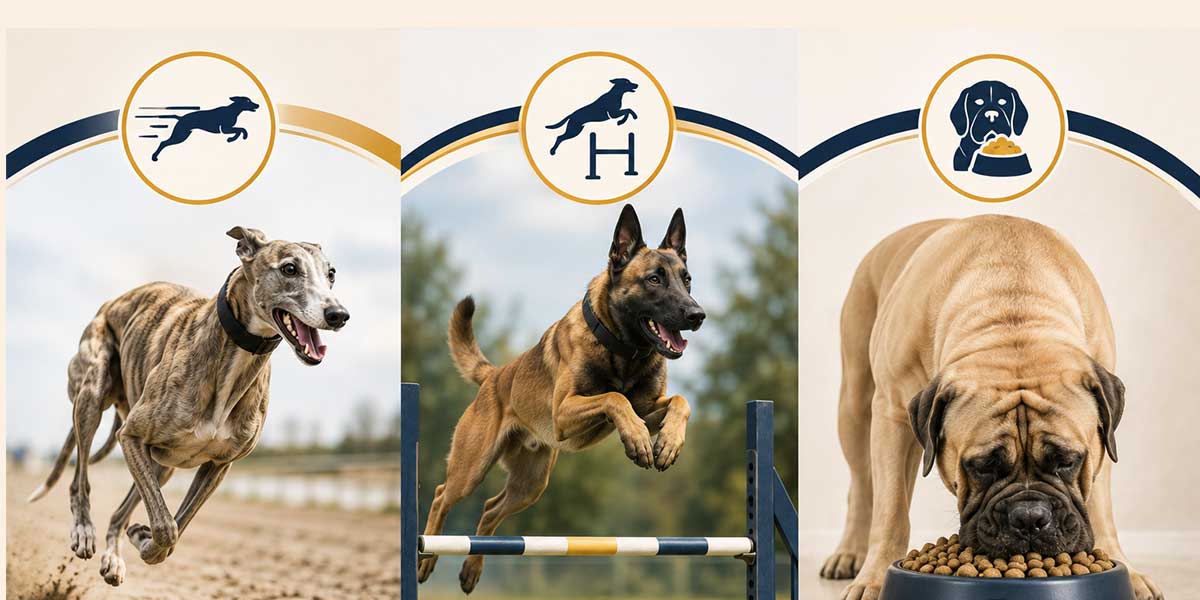
Some dogs are built to win a fight, some are built to guard a flock, and some are built to do exactly one thing better than every other dog on the planet. This is about that third group — the specialists. A Greyhound built for a straight-line sprint. A rescued racer who trained herself into a Guinness World Record. And two giant breeds whose daily food bowl looks more like a feed trough than a dog dish.
None of the numbers below are guesses. The speed and jump records come from Guinness World Records and the American Kennel Club, and the feeding figures come from breed-specific vet and nutrition sources. Here’s how fast, how high, and how much the most extreme dogs on record actually go.
What’s Inside!
The Fastest Dog Breed: How Fast Can a Greyhound Actually Run?
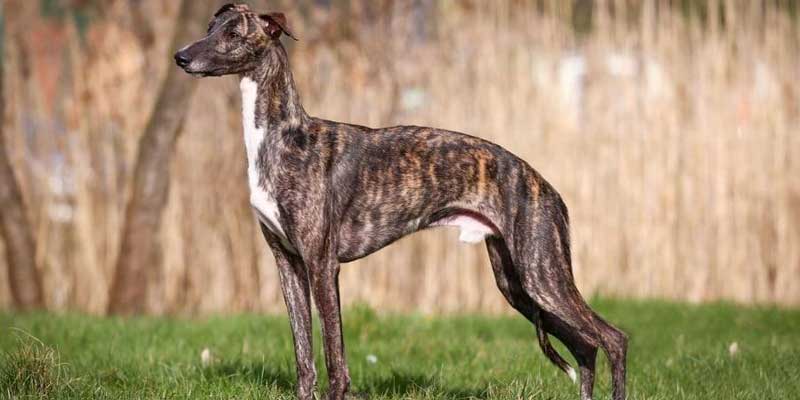
The Greyhound is the fastest dog breed alive, and it isn’t close. Most Greyhounds cruise at 35–40 mph when they open up, and the American Kennel Club puts the breed’s fastest officially recorded speed at 41.83 mph. That figure traces back to a real, documented run: Guinness World Records credits a Greyhound named Star Title with covering 366 meters (400 yards) in 19.57 seconds — 67.32 km/h (41.83 mph) — in Wyong, New South Wales, Australia, on 5 March 1994. It’s the oldest record in this article and it still stands.
The mechanics behind that speed are almost as interesting as the number itself. Greyhounds run with a double-suspension gallop — a stride pattern where the dog’s body is airborne twice per stride cycle, once with the legs fully extended and once with them fully tucked underneath. According to the AKC, a sprinting Greyhound spends roughly 75% of the race with all four feet off the ground. A narrow, aerodynamic skull, hare-like feet, and shock-absorbing paw pads round out a body built almost entirely around reducing drag and maximizing stride length.
Fact: a Greyhound at full speed is faster than the fastest human sprint ever recorded — Usain Bolt’s peak was about 27.8 mph. Only one land animal on Earth outruns a Greyhound: the cheetah, which the AKC puts at a top recorded speed of 64.3 mph.
What surprises a lot of first-time owners: that top-end speed doesn’t come with a high-energy personality at home. Greyhounds are sprinters, not distance runners, and most are content to spend the bulk of the day asleep on the couch between short bursts of activity — a reputation solid enough that greyhound rescue groups often describe the breed as “45-mph couch potatoes.”
Adult Greyhounds typically stand 27–30 inches tall and weigh 60–70 pounds, with the official AKC breed standard specifying 65–70 pounds for males and 60–65 pounds for females — and a life expectancy of roughly 10–13 years, according to PetMD.
Other Fast Dog Breeds Worth Knowing
Sighthounds as a group tend to dominate the top of the speed list — Whippets and Salukis both post times in the 35–40 mph range. But raw sprint speed isn’t only a sighthound trait. The AKC’s own Fast CAT program times any AKC-recognized breed over a straight 100-yard dash and converts the result to mph, and breeds that aren’t built like Greyhounds at all — Border Collies, Vizslas, even some terriers — regularly clock surprisingly fast times relative to their size once the handicap for height is applied.
The Highest-Jumping Dog: Feather’s 75.5-Inch World Record
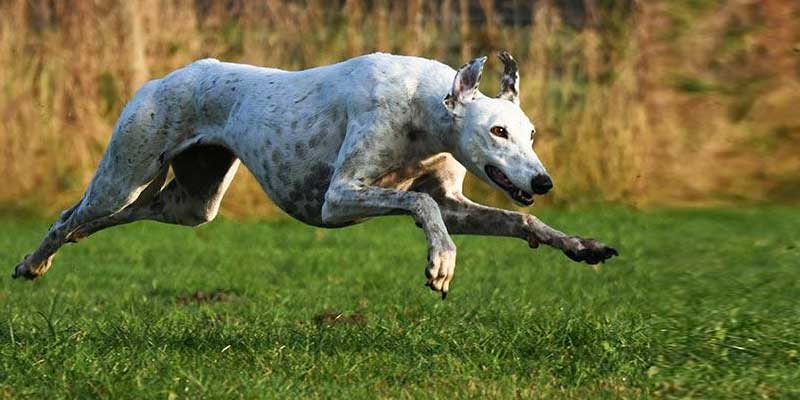
The same breed that owns the speed record also owns the high-jump record. Guinness World Records lists the highest jump by a dog at 191.7 cm (75.5 in), cleared by Feather, a two-year-old female Greyhound, in Frederick, Maryland, on 14 September 2017. Feather was owned and trained by Samantha Valle and cleared the previous record holder’s mark by more than 19 inches.
Feather’s backstory adds real weight to the number. She wasn’t bred for the record — she was a retired racing Greyhound adopted from Star City Greyhounds, a Virginia-based rescue organization, before Valle discovered her natural jumping ability and trained her into a world-record holder using positive-reinforcement obstacle work, according to reporting on the achievement.
That same explosive hindquarter drive and long-legged build that makes a Greyhound fast is what makes it a natural high jumper — a standing vertical leap draws on the same muscle power as a sprint start, just aimed straight up instead of forward.
A Different Record: Farthest Jump (Dock Jumping)
It’s worth separating Feather’s record from a different, easily confused one. Guinness also tracks the farthest jump by a dog (dock jumping) — a running long jump off a dock into water, scored for horizontal distance rather than height. That record belongs to Sounders, a seven-year-old Whippet owned by Laurel Behnke, who leapt 11.12 meters (36 ft 6 in) at a competition in Gig Harbor, Washington, on 30 July 2022. Feather’s record is a standing high jump measured in height; Sounders’ is a running long jump measured in distance — different sports, different dogs, different numbers.
Before you train a jumper: don’t start competitive or maximum-height jump training before 12–15 months old, and expect giant or slow-maturing breeds to need even longer. A puppy’s growth plates aren’t fully closed until at least 12 months, and jumping on open growth plates can cause lasting joint damage, according to the AKC. Casual jumping — off furniture, over baby gates, in and out of the car — carries the same risk and is worth limiting in young dogs too.
The Biggest Eaters: Giant Breeds That Need Massive Meals
Speed and jump height are about muscle and stride mechanics. The biggest-eater question is about something simpler: sheer body mass. The two breeds that consistently top “how much does this dog eat” searches are the Mastiff and the Great Dane — both giant breeds where a full-grown adult can weigh more than most adult humans.
Mastiff
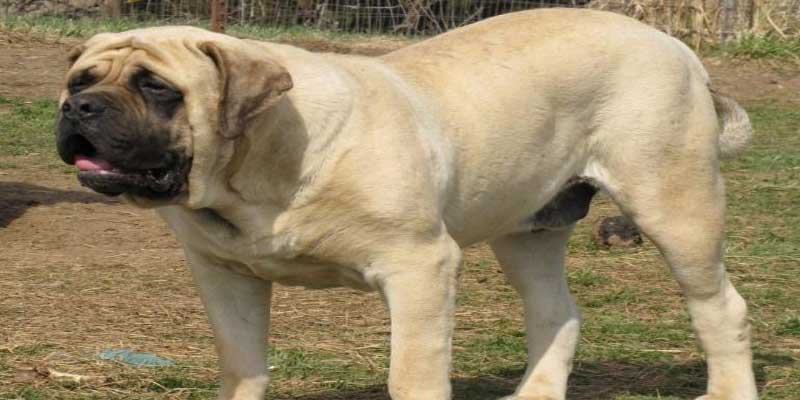
The AKC breed standard sets a minimum height of 30 inches at the shoulder for male Mastiffs and 27.5 inches for females, with some individuals reaching 36 inches. Weight ranges roughly 160–230 pounds for males and 120–170 pounds for females. Feeding a dog that size takes real volume — most sources put a healthy adult Mastiff’s daily intake at 6 to 10 cups of high-quality dry food, split across at least two meals.
Great Dane
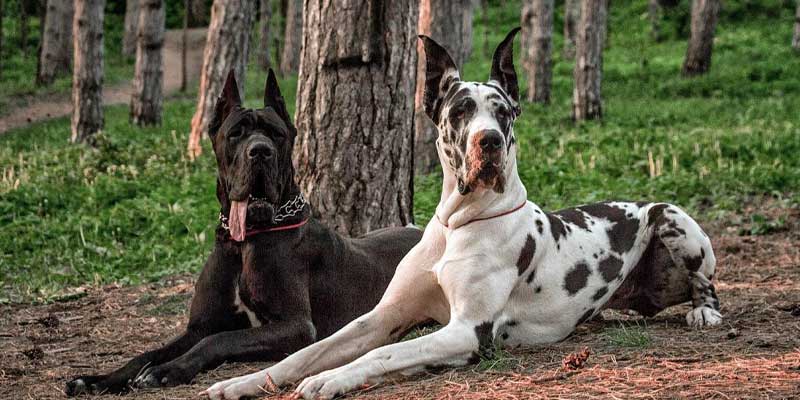
Great Danes run a similar scale. Males can reach up to 32 inches at the shoulder and 175 pounds, while females top out around 30 inches and 140 pounds, according to the AKC. That build calls for 5 to 10 cups of dry food a day, and the AKC notes plainly that feeding a Great Dane simply costs more than feeding a smaller dog — food, gear, transport, and vet care all scale with the dog.
See a vet if: a large, deep-chested dog’s abdomen suddenly looks swollen, or it retches without producing anything — those are hallmark signs of bloat (gastric dilatation-volvulus), a life-threatening emergency. The Great Dane is one of the breeds VCA Animal Hospitals names as highest-risk, and dogs over 100 pounds carry roughly a 20% lifetime risk. Rapid eating, one large meal a day, and heavy drinking right after eating all raise the odds — splitting a giant breed’s daily total into two or three smaller meals, as recommended above, is a real preventive step, not just a feeding preference.
Giant breeds don’t just eat more as adults — they need a different kind of feeding as puppies, too. Growing too fast under a calorie-dense diet stresses developing bones and joints, and unlike adult dogs, large-breed puppies can’t self-regulate how much calcium they absorb, according to VCA Animal Hospitals. That’s why large-and-giant-breed puppy formulas exist as their own category, not a marketing label — a Mastiff or Great Dane puppy fed like a small-breed puppy is at real risk of skeletal problems by adulthood.
Good to know: the largest dog Guinness World Records has ever verified was a Mastiff — Aicama Zorba of La-Susa, measured at 2.554 m (8.3 ft) nose to tail with an ideal weight of 144.66 kg (319 lb) in September 1987, per Guinness. In March 1989, after being overfed by a relative, he briefly ballooned to 153.5 kg (338 lb) before returning to a healthier weight — a real illustration of how easily a giant breed’s size can tip from impressive into unhealthy. (Some secondary sources round Zorba’s peak weight up to 343 lb; Guinness’s own published figures are the ones used here.)
If your own dog swings the opposite direction and won’t eat enough rather than too much, that’s a different problem with its own fix — see our guide to getting a reluctant eater to eat. And because giant breeds like the Mastiff and Great Dane also age on a different curve than small dogs, our breakdown of how dog years are actually calculated is worth a look if you’re weighing size against expected lifespan.
Extreme Dog Records FAQ
Is a Greyhound really faster than a cheetah?
No. A cheetah’s top recorded speed is about 64.3 mph, well ahead of the Greyhound’s 41.83 mph record. The Greyhound is the fastest dog breed, not the fastest land animal overall — the cheetah still holds that title.
How high can an average dog jump, compared to Feather’s record?
Most dogs, even athletic ones, clear a fraction of Feather’s 75.5-inch record without dedicated training. A well-conditioned medium or large dog might comfortably clear 3–4 feet; Feather’s jump was a trained, competition-level result from one of the most physically suited breeds for it.
Why do Mastiffs and Great Danes eat so much more than other dogs?
It comes down to body mass. Both breeds carry well over 100 pounds of muscle and frame at maturity, and calorie needs scale with body size — a dog that large simply burns, and therefore needs, far more energy per day than a 20-pound breed.
What’s the difference between the “highest jump” and “farthest jump” dog records?
They’re different events measuring different things. The highest jump is a standing vertical leap measured in height (Feather’s Greyhound record). The farthest jump is a running long jump into water, measured in horizontal distance (Sounders the Whippet’s dock-jumping record).
Is it safe to let my puppy jump before it’s a year old?
Keep jumping minimal — off furniture, out of cars, over gates — until at least 12 months, and hold off on any competitive or maximum-height jump training until 12–15 months, longer for giant breeds. A puppy’s growth plates aren’t fully closed before that point, and jumping on them can cause lasting joint damage.
References:
- https://www.akc.org/expert-advice/lifestyle/fun-facts-greyhound/
- https://www.akc.org/sports/coursing/fast-cat/
- https://www.guinnessworldrecords.com/world-records/64107-fastest-greyhound
- https://www.guinnessworldrecords.com/world-records/23431-highest-jump-by-a-dog
- https://www.guinnessworldrecords.com/world-records/106242-farthest-jump-by-a-dog-dock-jumping
- https://rockykanaka.com/former-shelter-dog-sets-world-record-for-highest-jump/
- https://www.guinnessworldrecords.com/world-records/72865-longest-ever-dog
- https://www.akc.org/expert-advice/training/puppies-dogs-jump-safely/
- https://vcahospitals.com/know-your-pet/bloat-gastric-dilatation-and-volvulus-in-dogs
- https://vcahospitals.com/know-your-pet/nutritional-requirements-of-large-and-giant-breed-puppies
- https://images.akc.org/pdf/breeds/standards/Greyhound.pdf
- https://www.petmd.com/dog/breeds/c_dg_greyhound
- https://www.akc.org/expert-advice/dog-breeds/fun-facts-mastiff/
- https://iheartdogs.com/how-much-do-you-feed-a-mastiff/
- http://www.akc.org/expert-advice/lifestyle/8-facts-about-great-danes/
- https://www.dogster.com/dog-nutrition/how-much-food-does-a-great-dane-need/