A lot of the most recognizable dogs in movies and cartoons aren’t invented characters at all. They’re real, AKC-recognized breeds, sometimes played by an actual dog on set, sometimes drawn from a cartoonist’s own childhood pet. Scooby-Doo, Snoopy, Cujo, and Beethoven have been must-watch dogs for generations, and each one is built on a specific breed with its own size, temperament, and health profile that has little to do with how the character behaves on screen.
Here’s what breed each one actually is, how the on-screen dog compares to the real animal, and a few production details that go past the usual quick-answer trivia.
What’s Inside!
What Breed Is Scooby-Doo? Meet the Great Dane Behind Him
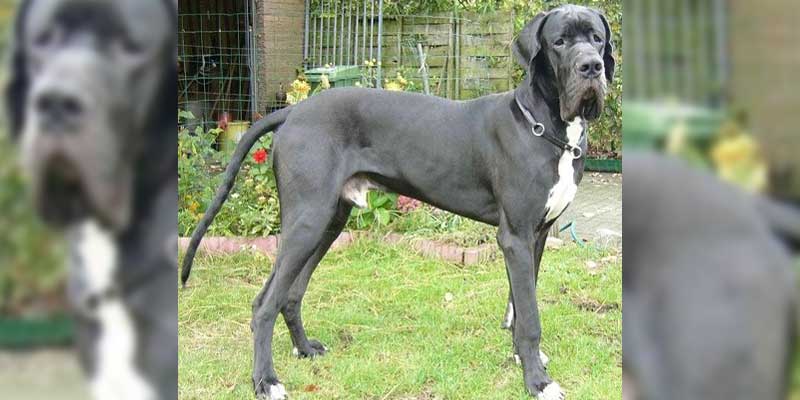
Scooby-Doo, Where Are You! first aired on September 13, 1969, and the cowardly Great Dane at the center of the Mystery Machine gang was designed by Hanna-Barbera animator Iwao Takamoto. Takamoto later said he built Scooby by talking with a friend who bred Great Danes, then deliberately reversing everything she described as ideal for the breed. “I decided to go the opposite and gave him a hump back, bowed legs, big chin and such. Even his color is wrong,” he told the Television Academy.
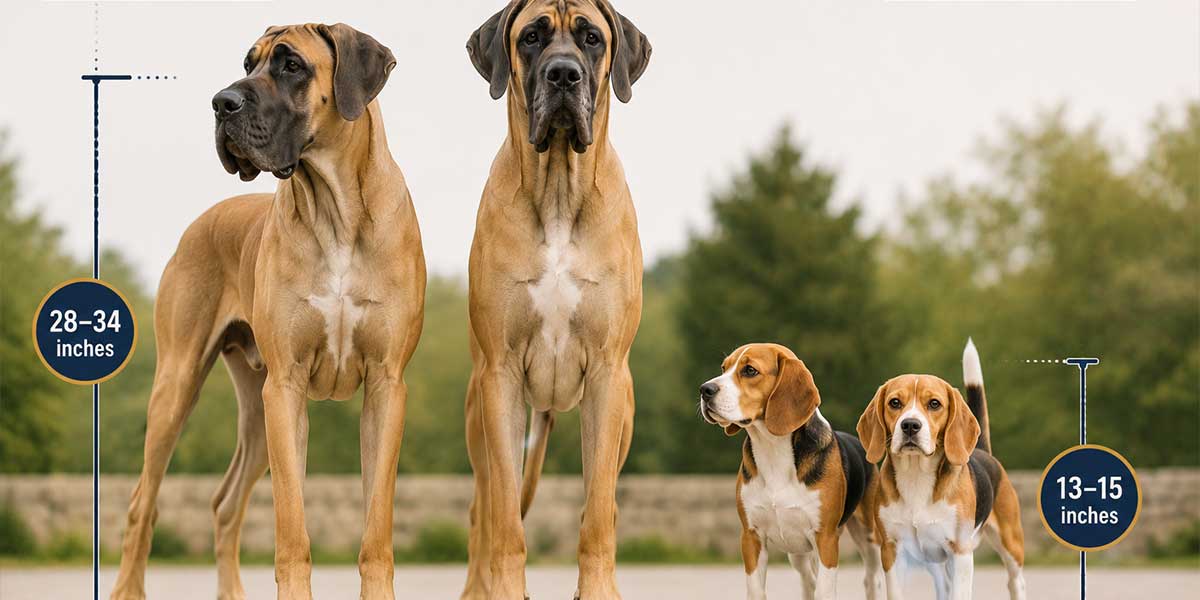
A real Great Dane looks nothing like that description. Adult males stand 30-32 inches at the shoulder and weigh 140-175 pounds, with females a little smaller at 28-30 inches and 110-140 pounds, carrying a smooth, short coat in fawn, black, mantle, harlequin, or blue, according to the PetMD breed profile. Straight legs, a straight back, and a fine chin — the exact opposite of Scooby’s design — are the actual show-ring standard.
Great Danes carry the “gentle giant” reputation for a reason: calm, affectionate, and easy to train despite their size. That size comes at a cost, though. A typical lifespan runs only 7-10 years, well short of what most mid-size breeds reach. Giant breeds living shorter lives than small ones is a well-documented pattern across dogs generally — our guide to how dog years are calculated covers how that size-to-lifespan gap plays out across breeds of very different sizes.
Fun fact: The tallest dog ever officially measured was a Great Dane. Zeus, owned by a Michigan family, stood 44 inches (1.118 m) at the shoulder — taller than most kitchen counters — according to Guinness World Records.
The size also brings a real, breed-specific health risk that has nothing to do with cartoons. Great Danes are one of the breeds most predisposed to bloat, or gastric dilatation-volvulus (GDV), a life-threatening emergency in which a dog’s stomach fills with gas and can twist on itself. Dogs over 100 pounds face roughly a 20% lifetime risk of bloat, per VCA Hospitals, and large, deep-chested breeds like the Great Dane are squarely in the highest-risk group.
What Breed Is Snoopy? The Real Beagle Behind Charlie Brown’s Dog

The Peanuts comic strip debuted on October 2, 1950, and Snoopy joined the cast just two days later. Cartoonist Charles Schulz based the character’s black-and-white markings on Spike, his own childhood dog, though the strip identified Snoopy as a Beagle from the start, per the AKC. Spike himself was a mixed breed, not a purebred Beagle — Schulz borrowed the look, not the pedigree.
Real Beagles are small-to-medium scent hounds. The AKC standard describes two size classes: 13 inches or under at the shoulder (20 pounds or less), and 13-15 inches (20-30 pounds). Lifespan runs 10-15 years — noticeably longer than the giant breeds in this article — per PetMD. The breed was developed to hunt rabbits by scent, working in packs and following a trail with their nose to the ground, and that drive is still the defining trait of a real Beagle today.
Beagles are also famously vocal, but not always in the way a bark implies. They “bay” — a long, distinctive howl used to signal that they’ve picked up a scent trail — alongside a regular bark, and it’s one reason Beagles rank among the most talkative breeds on record. Different breeds lean on different signals to communicate distance and intent; our guide to how dogs communicate with each other goes into how that varies across breeds.
Good to know: Snoopy has an actual job at NASA. The agency’s Silver Snoopy award, established in 1968, is a sterling silver lapel pin — one that has flown on a real space mission — given personally by an astronaut to a small share of employees and contractors each year for contributions to human flight safety or mission success, according to NASA.
What Breed Are Cujo and Beethoven? Same Breed, Opposite Reputations
Cujo and Beethoven are both St. Bernards, and they’re about as far apart in reputation as two dogs can get. One is a horror-movie villain; the other is a slobbery family comedy star. Neither has much to do with what a real St. Bernard is actually like.
Cujo (1983): A Rabid St. Bernard, Played by Several Friendly Ones
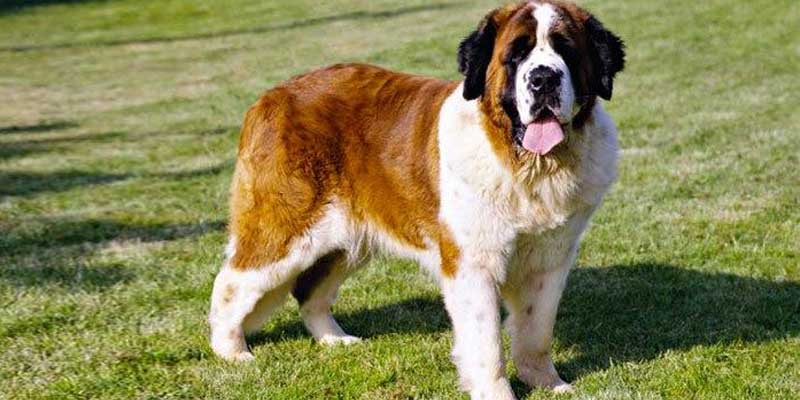
Stephen King’s 1983 film adaptation cast a St. Bernard as a family pet turned violent after a bat bite gives it rabies. Behind the scenes, the production reportedly auditioned around two dozen St. Bernards and settled on five, each trained for a different piece of the performance — one to bark on command, another to run a pre-set route, a third to lunge toward camera — because no single dog could carry every menacing beat the script needed, per Mental Floss.
The real dogs were the opposite of menacing. Crew members reportedly had to tie the St. Bernards’ tails down with fishing line during filming because they wouldn’t stop wagging on camera, and the production kept a mechanical head and a stunt performer in a dog suit on standby for shots the real dogs simply couldn’t sell.
Worth knowing: Rabies is a real disease, and unlike a movie plot, it isn’t tied to any one breed. It’s almost always fatal once symptoms appear, but it’s also almost entirely preventable — routine vaccination is highly effective, and it’s why rabies in pet dogs is now rare in the U.S. See the CDC’s rabies prevention guidance for what actually protects a dog.
Beethoven (1992): A Gentler St. Bernard Playing Against Type
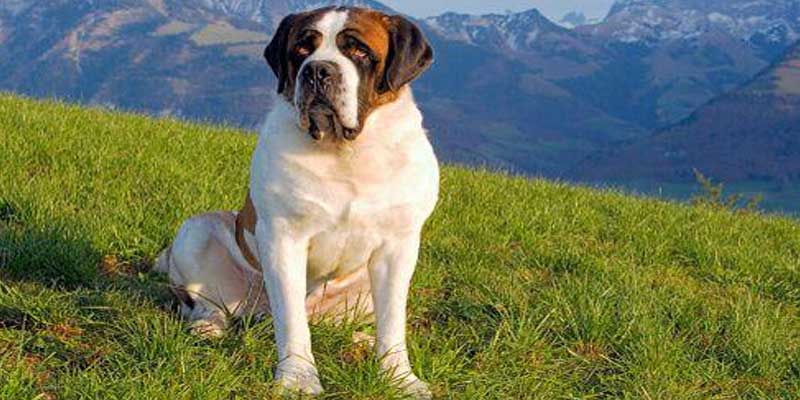
Nine years after Cujo, Beethoven put a St. Bernard back in front of audiences as a drooling, good-natured family dog instead of a horror-movie threat. The role leaned into everything real St. Bernards are actually known for, and it’s a large part of why the breed’s public image recovered after Cujo’s stretch as pop culture’s scariest dog.
That real reputation is centuries old. St. Bernards were developed by monks at the Great St. Bernard Hospice in the Swiss Alps to find and warm travelers stranded in snowstorms, and the AKC describes the breed today as “watchful, patient, and careful with children” — about as far from Cujo as a temperament description gets.
The most famous of the hospice’s rescue dogs, Barry, is credited with saving more than 40 people between 1800 and his retirement in 1812. His preserved body is still on display today at the Natural History Museum of Bern.
In real life, the breed is a giant one: adult females run 26-28 inches and 120-140 pounds, males 28-30 inches and 140-180 pounds, with a lifespan of 8-10 years. Like the Great Dane, that large, deep-chested build puts St. Bernards in the same higher-risk group for bloat discussed above — a real, breed-relevant health note that neither movie mentions.
Cujo and Beethoven are, in the end, the same real dog wearing two different scripts. The breed itself never changed — only which story it was cast in.
Quick Answers About Famous Movie and Cartoon Dogs
Is Scooby-Doo a real dog breed?
Scooby-Doo isn’t a breed on his own — he’s a Great Dane, exaggerated on purpose. Animator Iwao Takamoto based the design on a real Great Dane’s traits, then reversed them (hump back, bowed legs, oversized chin) to make Scooby look unmistakably cartoonish rather than show-ring correct.
How big do Great Danes actually get?
Adult males typically stand 30-32 inches at the shoulder and weigh 140-175 pounds; females run slightly smaller at 28-30 inches and 110-140 pounds, per the PetMD breed profile. The tallest dog ever recorded, Zeus, was also a Great Dane, at 44 inches to the shoulder.
What breed is Snoopy from Peanuts?
Snoopy is a Beagle. Charles Schulz gave him the black-and-white coloring of his own childhood dog, Spike, but wrote Snoopy as a Beagle from the character’s first appearance in 1950.
Was Cujo a real dog?
Cujo is a fictional character from Stephen King’s novel, but the 1983 film used real, friendly St. Bernards on set — reportedly around five different dogs, plus a mechanical head and a stunt performer in a dog suit for the most aggressive shots.
Do St. Bernards make good family pets, given Cujo’s reputation?
Yes — the AKC describes the real breed as watchful, patient, and good with children, and its centuries-long history as an Alpine rescue dog backs that up. What a family does need to plan for is the breed’s giant size: a shorter lifespan than most mid-size dogs, higher food and space needs, and an elevated bloat risk shared with other large, deep-chested breeds.
Are any other famous movie dogs based on real breeds?
Plenty. Toto in The Wizard of Oz (1939) was a Cairn Terrier named Terry, and the AKC’s own breed history credits that performance with a lasting jump in the Cairn Terrier’s popularity. Lassie, meanwhile, is a Rough Collie — a breed AKC still profiles today largely because of the character’s fame.
References:
- Television Academy — Animator Iwao Takamoto Dies (Scooby-Doo’s design origin)
- PetMD — Great Dane Breed Profile
- Guinness World Records — Tallest Dog Ever (Male)
- VCA Hospitals — Bloat (Gastric Dilatation-Volvulus) in Dogs
- AKC — Snoopy History: Behind the Iconic Cartoon Beagle
- PetMD — Beagle Breed Profile
- NASA — Silver Snoopy Award
- Mental Floss — 13 Rabid Facts About Cujo
- CDC — Rabies Prevention and Control
- AKC — St. Bernard Breed Page
- Natural History Museum of Bern — Barry Exhibition
- AKC — Fun Facts About the Cairn Terrier (Toto)
- AKC — Collie Breed Page (Lassie)