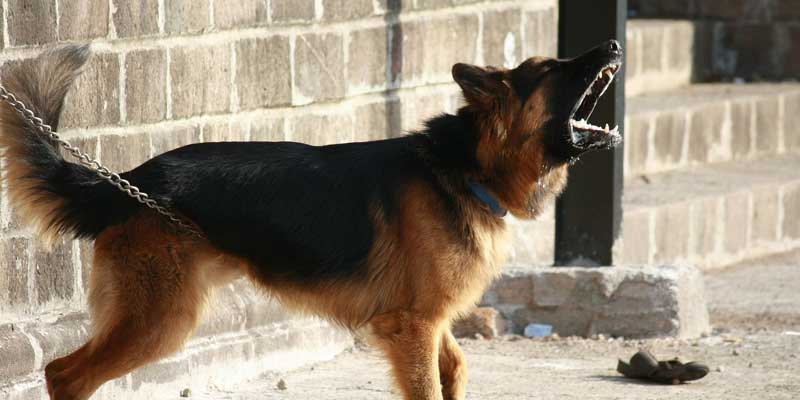
Before picking a device, ask why your dog is barking. Attention-seeking, boredom, territorial alerting, and anxiety all look similar from the outside but call for different responses. A bark collar can quiet the symptom while leaving anxiety-driven barking untouched — and in that case it can make things worse.
One marketing claim needs correcting up front: an approved device will not automatically “not harm your pet in any way.” Misuse causes real harm; use at the lowest effective setting, with a full introduction period, doesn’t. Small dogs leave less room for error, and for most of them beep and vibration are enough — which is why several collars below never apply static at all.
Editor’s Pick

Last update on 2026-10-07 / Affiliate links / Images from Amazon Product Advertising API
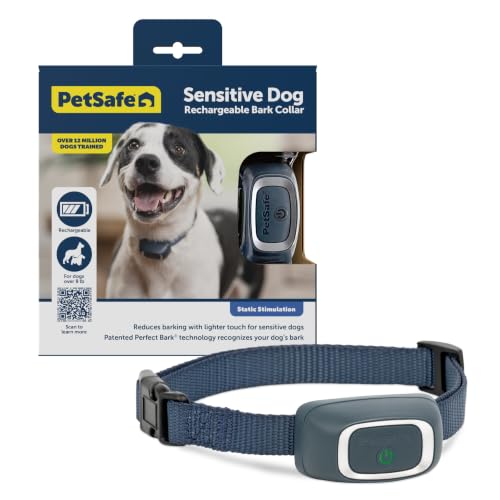
Built for timid and little dogs: correction starts at the lowest level, rises only if barking continues, and steps back down as the dog quiets — the approach this whole guide is built around.
What’s Inside!
Why Dogs Bark

A few distinct causes cover most cases. Attention-seeking barking is learned — if barking has ever reliably gotten a response, a dog will keep using it. Boredom shows up in dogs without enough physical or mental stimulation. Territorial or alert barking responds to people, animals, or activity near the home. Anxiety, including separation anxiety, is different from the others — it usually comes paired with other signs like pacing, destruction, or accidents, and Cornell’s veterinary college notes that fear-driven barking is often part of broader reactivity, not a standalone behavior a device alone will fix.
If barking is new, sudden, or paired with other behavior changes, rule out a medical cause before assuming it’s purely behavioral. And if you’ve identified anxiety as the driver, a bark collar isn’t the right primary tool — punishing an anxious dog for expressing distress can deepen the anxiety, not resolve it. Address the underlying cause with a vet or behaviorist first.
What to Look For
Mechanism. Beep and vibration handle most small dogs. Static correction can be used safely at low levels, but plenty of well-reviewed collars skip it entirely.
Adjustable, low-starting levels. A collar that starts at the lowest setting and escalates only if needed is safer than one that jumps straight to a fixed intensity.
Dual-sensor detection. Collars that require both vibration (from your dog’s own vocal cords) and sound before triggering are less prone to false corrections from another dog barking nearby.
Fit for a small dog. Don’t assume “adjustable” covers it; check the weight and neck-size range. A collar built for dogs 8 pounds and up can be too bulky for a true toy breed.
Bark Collar Comparison Table


Last update on 2026-10-07 / Affiliate links / Images from Amazon Product Advertising API
Bark Collar Reviews
1. PetSafe Lite (Best for Timid/Anxious Dogs)
Best for Timid/Anxious Dogs
Last update on 2026-10-07 / Affiliate links / Images from Amazon Product Advertising API
- Mechanism15 auto-adjusting static levels, starts lowest
- DetectionDual sensor, sound plus vibration
- Best ForDogs 8lb+, timid or easily startled temperaments
PetSafe sells this as the “Timid/Little Dogs” version of its rechargeable bark collar — the same dual-detection design in a smaller collar, with slightly lower stimulation levels than the standard model, by PetSafe’s own description.
Correction begins at the lowest of the 15 levels and climbs only while barking continues; once the dog stays quiet, the level drops back down automatically. The collar fires only when it senses both sound and vibration from the dog’s own throat, so a housemate’s bark or street noise won’t set it off.
PetSafe rates the battery at up to 40 hours from a two-hour charge, with waterproofing to three feet and a strap fitting necks up to 23 inches — the company’s numbers, and that battery window means charging every couple of days, against the two weeks DogRook claims for the collar below.
It is still a static-correction collar. If any static at all is a dealbreaker for you, the DogRook below never uses it.
Pros
- Low-start, auto-adapting correction levels
- Dual-sensor detection prevents false triggers
- Built for small, timid dogs
Cons
- Still uses static correction, even if minimal
2. DogRook (Best No-Shock)
Best No-Shock

Last update on 2026-10-07 / Affiliate links / Images from Amazon Product Advertising API
- MechanismBeep and vibration only, no static option
- BatteryUp to 14 days
- Best ForOwners who want static correction off the table entirely
There is no static hardware here to disable — the collar only beeps and vibrates, stepping between the two as barking continues. DogRook lists five vibration levels, a 70-gram receiver, up to 14 days per charge, and a minimum dog size of 8 pounds and six months old.
One reader commented on the original version of this article that a friend’s DogRook worked well — and that it was picked in the first place because it had no shock feature.
Owner reports collected by Canine Journal, which still names it the best no-shock pick, include buckles popping open and false corrections when another dog barks nearby. The same review cautions that sound and vibration alone don’t always stop a stubborn barker.
There’s no remote either, so you can’t trigger a correction yourself; the collar decides when.
Pros
- No-shock by design, not just switchable
- Positive owner feedback
- Long battery life
Cons
- No remote; owners report popped buckles and false triggers
3. Dogtra Smart NOBARK (Best Smart/App-Connected)
Best Smart/App-Connected

Last update on 2026-10-07 / Affiliate links / Images from Amazon Product Advertising API
- DetectionTriple detection accuracy, whining and barking
- ConnectivityApp notifications, 33ft range
- Best ForCompact dogs down to 10lb, owners wanting behavior tracking
Dogtra has made training collars for decades, and this is its app-connected bark collar: it pairs with a phone over Bluetooth within about 33 feet, sending notifications and a behavior report with no subscription fee, so you can see when and how often the barking happens. Past that range the collar keeps working on its own.
Detection covers whining and howling as well as barking, filtered through sound and vibration sensors so background noise doesn’t trigger it. A vibration-only mode lets it run without any static, and Dogtra rates the housing IPX9K — a pressure-washdown standard well past the splash resistance most bark collars carry.
It is also the higher-priced, higher-complexity route: if the problem is plain alert barking, a collar without an app covers the same basics. And the short Bluetooth range means the app only updates with the dog nearby.
Pros
- App connectivity and behavior tracking
- Detects whining as well as barking
- IPX9K waterproof rating
Cons
- Priced above simpler collars, more complexity than some need
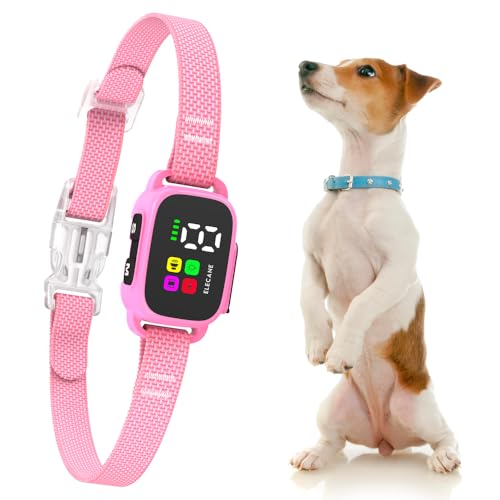
4. Tiny Bark Collar (Best for Truly Tiny Dogs)
Best for Truly Tiny Dogs
Last update on 2026-09-28 / Affiliate links / Images from Amazon Product Advertising API
- MechanismNo shock, beep and vibration, 7 sensitivity levels
- Sizing5-15lbs
- Best ForSmall dogs and puppies
Sized for dogs from 5 to 15 pounds — the range this article is aimed at. Many collars claim an all-size fit because the strap cinches down; this one has a small receiver to begin with, built for toy breeds and puppies.
The hardware never applies static. You get beep and vibration with 7 sensitivity levels and 3 response modes, so you can tune how soon it reacts and how firmly.
The same sizing caps it at 15 pounds, so a home with one small dog and one bigger dog can’t share it. It also lacks the independent-review coverage the bigger brands here have; what’s known about it comes from the maker and from owner feedback.
Pros
- Sized for 5-15lb dogs
- No-shock hardware with 7 sensitivity levels
- Built for puppies as well as small adult dogs
Cons
- Not designed to scale up for larger dogs
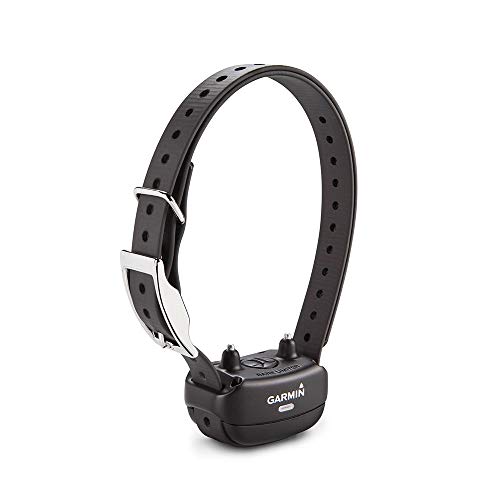
5. Garmin BarkLimiter Deluxe (Best Premium/Established Brand)
Best Premium/Heritage Brand
Last update on 2026-10-07 / Affiliate links / Images from Amazon Product Advertising API
- HeritageBuilt on Tri-Tronics training technology
- AdjustabilityMultiple stimulation levels
- Best ForOwners who want a long field record behind the device
The design goes back to Tri-Tronics, the training-collar maker Garmin bought, and it had years of field use under that name before this version. Bark detection runs on acceleration sensors reading movement at the dog’s throat, not a microphone.
Autorise mode starts stimulation at the bottom level, steps it up while barking continues, and brings it back down once the dog stops — the same low-and-slow pattern as the PetSafe. There are also 7 fixed levels and a vibration-only setting, and Gun Dog Supply’s long-term review reports months of battery per charge from a receiver of about two ounces.
That review also flags two weak points: the included strap drew complaints, and on thick-coated dogs the contact points can fail to reach skin consistently. Expect to pay more for it than for anything else in this guide.
Pros
- Tri-Tronics/Garmin brand heritage
- Autorise plus 7 fixed levels and vibration-only mode
- Months of battery life per charge
Cons
- Priciest collar here; strap and thick-coat contact complaints
Which Bark Collar Should You Buy?
| Situation | Pick |
|---|---|
| Timid or anxious small dog | PetSafe Lite |
| Want static correction off the table entirely | DogRook |
| Want app notifications and behavior tracking | Dogtra Smart NOBARK |
| Tiny dog, 5-15lbs | Tiny Bark Collar |
| Want the longest track record in the category | Garmin BarkLimiter Deluxe |
Bark Collars for Small Dogs FAQ
Is it true that an approved bark collar can’t harm my dog?
Not quite. Misuse — jumping straight to a high stimulation level, skipping a proper introduction — can cause genuine stress or harm. Proper use, starting at the lowest effective setting with a full introduction period, doesn’t. This is true of bark collars the same way it’s true of training collars generally.
My dog barks when I leave. Will a bark collar fix this?
Possibly not on its own. If the barking is driven by separation anxiety, a bark collar addresses the symptom without the underlying cause, and punishing anxious behavior can make the anxiety worse. Look for other signs of anxiety — pacing, destruction, accidents when alone — and address those with a vet or behaviorist if present.
Do small dogs need a different collar than large dogs?
Yes. A collar rated for “all sizes” that happens to have a small enough strap setting isn’t the same as one sized and weighted for a toy breed. Check the weight range and collar bulk, not just adjustability.
Should I start with a no-shock option before trying static correction?
For most small dogs, yes — beep and vibration often do enough, and several well-reviewed collars use no-shock mechanisms entirely. If those fail after a fair trial, a low-starting, auto-adjusting static option is the next reasonable step.
Final Thoughts
Figure out why your dog is barking before choosing a device — the right response to boredom is not the right response to anxiety. Whatever you buy, start at the lowest effective setting. And if anxiety turns out to be the driver, treat the cause with a vet or behaviorist; a collar alone won’t fix it.

My friend Sam owns a DogRook bark collar and it’s working very good, I was looking for some references to buy it, and so I found on this website. The best thing, it doesn’t have a shock feature.
This is exactly what I was looking for, thank you twodogzoo
Thanks for share this article it is quite helpful to me.
Best regards,
Boswell Griffin